Monday, September 9, 2013

Just been reading Ardy's build and something worries me...


Hi Kevin, just been reading Ardy's build and something worries me...with using Zeolite and it absorbing all the ammonia if for any reason he had to add salt (as I do from time to time) all the absorbed ammonia would be released into the water which would be bad!! I was wondering if he knows salt would be a bad thing now. Its great the anoxic is catching on got a feeling it might snowball :)

Brian

Thanks Brian for the heads-up!

Salt is used as a recharging agent for Zeolite. I completely forgot about Sodium chloride (salt) as a recharging agent because I do not use salt in my pond nor do I use Zeolite. Read my post about salt: http://drklnovak.blogspot.com/2013/06/salt-and-cyprinus-carpio-carassius.html

 Read what Duncan has written about salt in much greater detail, click below.


Sodium chloride is a Band-Aid for incompetent filtration system if you have to use it to make Nitrites less toxic to Koi, then something is not right with your filter. Understanding that in springtime the use of salt may be more acceptable than other times of the year as a new filter is cycling but as an all-time prophylactic I would not recommend it.

As we all know most pond hobbyist use salt as a medication and I hope Andy knows that may not be an option for him. However, if the Biocenosis baskets are mature and the facultative bacterium is active then salt would not release anything from the Zeolite. Much like that of cat litter that has a crystalline structure too like that of Zeolite the bacteria would just use the available Ammonium ion as a food source so it would keep attracting more ammonia out of solution and never become exhausted like that of cat litter.

If you think about it how could the Biocenosis baskets keep attracting the ammonia/ammonium out of a solution without becoming at some point exhausted within a shot time instead of lasting ten years or longer? There is constantly and exchange going on inside the Biocenosis baskets at all times. One ion is being exchanged for another ion and in the end N2 is the byproduct of the bacteria in the media.

Once the Biocenosis baskets are seasoned it would be interesting to see through a simple experiment if salt would release any of the trapped ammonia ion back into solution. By taking a Zeolite Biocenosis basket and placing it into a bucket with some salt in it at the same concentration most hobbyist would use in their ponds. Then with an Ammonia test kit, test the results. Definitely this would be an interesting experiment.


Anoxic Filtration System ®
February 02-2005-2013
New Updated Version

Sunday, September 8, 2013

Ardy’s Anoxic Filter from Indonesia... update with photos.


To my observation after one day the water seems to be better. Maybe because I put in 25kg Zeolite that right away absorbs the ammonia in the water.

Btw, the basket is 250mm in diameter with 156mm in height.

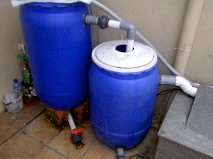
I have small pond, only 1.75m x 1.75m x 0.45m with 13 Koi, 8 Koi around 45cm and the rest between 25 - 30cm. I use external DIY filter using 2 blue barrels (120ltrs and 100ltrs) both fully loaded with BioBalls. Total I have 1.2 tons of water with 13 Koi in it and equally over stocked with fish. I used to feed them 5 times a day with medium amount of growth and color food. But since last month I have been feeding three times a day in small amount of balanced diet food (not growth nor color food) just to maintain the water parameter in its edge.

My pond is 1-year-old now, water change is 20% daily and suddenly it crashed on me and turned green just a day before I found your AFS. I also believe my filter cannot handle my overstock fish pond due to it being already at maximum capacity, so I cleaned my pond and filter again thus now everything has to restart all over.

I use submersible pump (with DIY skimmer) to pump 4800ltr/hour of water to 10" canister filter with gravel to 120ltr blue barrel BioBalls and to 100ltr blue barrel with 8 Biocenosis baskets in it stacked (3x2 and 1x2). Because of the lack of space I cannot put a diffuser.

If everything works after 6-8 weeks, I will replace all BioBalls in 120ltr blue barrel with 12 more Biocenosis baskets.

Still, have one problem through, my mechanical filter! I need to think fast and be frugal because I don't really have that much of a budget for my pond. That is why I love your AFS system. Until now I only spent a total of $31.70 for JBL Aquasis, Plus 6kg --> $19.50, Zeolite 25kg --> $4.20, for Round Basket (@$1) --> $8.00

I will have another update again soon. And once again Dr Kevin, many many thanks for your Anoxic Filtration System and your help along the process.

Best Regards,
Ardy 


Ed: Thanks Ardy for the information about your pond and photos. Hopefully this will help those hobbyists that are on a budget and yet realize Koi will outgrow any filter very rapidly if filtration is its weakest link. I would in the future replace both Blue filter barrels with one long Anoxic Filter in that corner and make it look like the rest of your ponds color and build. It would look cosmetically neater and be easier on maintenance. You could even add a lid to cover it or leave it open and grow some aquatic plants out of it like Brian’s Anoxic Filter in the UK. The plats would add some color to that room. Well that’s my two cents worth!


Anoxic Filtration System ®
February 02-2005-2013
New Updated Version

Saturday, September 7, 2013

Because of Ardy’s innovation in Indonesia…JBL’s Aquabasis Plus is a substitute for Laterite; see why!


Quote I made over eight years ago: “Innovation has been the growth engine of this hobby from the very beginning, on both the aquatic animals and the hardware sides.” I have never been so egotistical that I can’t learn from even the newest or less experience to the most über experts of hobbyists. Because of the very wide geographical area of hobbyists using the Anoxic filtration system innovation drives them to discover new and/or better ways to make up the Biocenosis baskets in their countries.

Lets take this guy Ardy for example that I have been communicating with far sometime now. Ardy lives in Indonesia and because of his lack of wherewithal’s on his filtration build, he has become very innovated in implementing an Anoxic filtration system.  Ardy is faced with the same problems, as other Koi keepers in his country are; like available pond goods that most of us take for granted and we fail to appreciate how lucky we are.

The next photos are going to show you how through innovation and research he has come up with some solution to several problems making up the Biocenosis basket for his pond in his country. Through the communications of cyberspace he has found products and shown them to me to see if they would be valid commodities for his filter.

I also want to point out the misconception that some may have about the Anoxic filtration system. An Anoxic filtration system is not a filter, it is a clarification system different than what you’re use to seeing or what is being sold as filtration systems. The thing you must remember about this system in opposition to other systems is that each basket can theoretically be said that they are sitting in the filtration system or a vessel to hold the Biocenosis clarification baskets. That is the process of passing water through or putting something through the filtration system itself, not that the baskets themselves are the filtration system. Therefore, each basket technically can be said to be a biocenosis clarification basket. The baskets themselves aid in the process of PURIFYING water through a chemical and metabolic reaction making our pond water crystal-clear, clean of biological and chemical pollutants and free of ion impurities. Because water is not forced through the filter media itself like all other filtration system do, the baskets then are only a constituent of the filtration system inner workings but not the filtration system itself.


For those that have troubles getting Laterite, maybe Ardy has found a good substitute. Innovation has been the growth engine of this hobby!


Instead of cat litter Ardy has to use Zeolite as a substitute media for the Biocenosis baskets.


This is what JBL’s Aquabasis looks like up close.


Once again the black open-cell plant baskets are not that readily available in Indonesia but these brightly colored ones are. He uses a 3" diameter PVC pipe to make the indentation in the center of the baskets then fills it with Aquabasis. He then removes the small piece of PVC pipe and you now have a perfect separation of the two mediums. 


Anoxic Filtration System ®
February 02-2005-2013
New Updated Version


Friday, September 6, 2013

Now for some E-mail...


Now for some E-mail...


NOTE: Please remember that these are untouched E-mails from hobbyist to myself, and spelling and grammar may no be accurate in the correspondents.


Dear Dr. Novak, Hope you are having a great summer. I talked to you last year at the pond expo in Cedar Rapid and corresponded several times. If you remember, I struggled with water clarity and after hearing your talk, added a filter pond with the kitty litter/Laterite mix, removed all dirt from all my plant material. I wanted to give you an update. My water clarity has been EXCELLENT this year. I still struggle with some spaghetti-algae, but my water has been crystal clear all year. I have been on garden tours and have been the hit! I thought that you might enjoy seeing some picture of my larger pond. I have Koi in the bottom pond and have enjoyed actually getting to SEE them this year! Thanks for you help! Sincerely, Kim Davis P.S. Hopefully these picture get through! Photos by: Kim Davis Iowa


Dr Novak
This is good stuff here. Man, it's great! Already have made some design decisions. I'm currently reading it for the second time.

I just have to know though, is your water clear as a bell and seams to be thin like water is supposed to be?
Actually I believe that My email was broke. I just got it fixed last week.
Mickey


From:-------------------
> Date: Mon, 19 Nov 2007 19:03:00 +0000 > To: drklnovak@gmail.com
> Subject: Anoxic System
>
> Dear Dr. Novak,
>
> I'm not sure if this email address is current.
> I just wanted to send you a quick note to thank you for the anoxic idea.
> I built the system last spring and had a wonderful maintenance free season with my Koi. > Cheers,
> Nolan Baird > Johnsburg, IL


Today I received an e-mail asking for one of my CDs, and telling me that a person on the Internet wanted to ask me some questions. He thought that these questions would require my immediate attention.

I will try to address the questions that James has asked of me. James asks if a system is producing excess amounts of harmful pathogens then there is something definitely wrong with that system. Meaning of course, there are too many fish, the fish are being excessively fed, the filtration system is inadequate in handling fish load plus any if not all harmful pathogens, the water parameters can become way off, inadequate water turnover through the filtering system itself, and proper pond husbandry is being improperly executed or ignored by the hobbyist, etc., etc.

His question is: So why would you wish to intercede “after the fact” rather than addressed the actual causes of the rising bacteria count?

This is an excellent question that James brings up, and makes a very good point. Why would one, wish to intercede after the fact? I know I would not, and most hobbyists I trust would not either. All filtration systems out there are specifically designed to slow down the deterioration of pond water, but not or cannot stop it.

The Anoxic filtration system, which I have designed, is not only capable of handling the hobbyists ponds with which it was originally designed for, but also on a more professional level can be used in saving our environment. Many scientists including myself are trying to do just that. The system has the capability of removing Phenols from heavily loaded water along with the removal of cyankali, carbolic acids, and detergents from sewerage treatment facilities. In addition to a number of other bacteria such as Escherichia coli, Bacterium coli along with germs like enterococci and salmonella. The systems that most hobbyists are using do not have the capabilities of dealing with any of these germs or bacteria. Unbelievably, most of these bacteria and germs do exist in all hobbyist ponds to some degree. This may be due in fault to the hobbyists doing something wrong or from other outside sources such as animal’s coming into the pond environment. Hobbyists have no control in these circumstances. I guess what I am trying to say is: The hobbyists are at the mercy of the environment and geographical location in which their pond is located in, and not necessarily will this be the fault of the hobbyists themselves. Therefore as a scientist, I tried to deal with all the problems that hobbyists might have to deal with, even if they do not even know they existed. Moreover, sometimes this may have to be “after the fact.”

We do not live in a perfect world and hobbyists are not perfect individuals they make mistakes, as all human beings do. This filtration system was designed for what I call the “mom and Pop” ponds. Unlike you who are a professional at pond keeping, many people are not; they are constantly having problems with their ponds environment on a daily basis. I hope I am using the term “professional” correctly, based on your intelligent question. I think you know exactly what I mean, not all people know not to over feed, not to have too many fish (some hobbyist refused to listen to anybody on that subject) and in doing the proper maintenance on their pond. We all know that people sometimes get lazy and do things like that, which is just being human. This system is designed to give the hobbyists a cushion, better than most systems do or will because it does not clog like other systems.

I would also like to say James; to call you one of those nonprofessionals is taradiddle. I bet your one of those hobbyists that has a cost-no-object über expensive filtration system for your animals'. You will do anything at any cost to make sure your animals' live in secure, comfortable, and clean environment. You more than likely are a prime example of what hobbyist should be doing and not what they should not be doing! Unfortunately, most people do not have the wherewithal for such filtration systems and therefore have no other way of enjoying this hobby except going on the cheap. These cheaper systems cannot in any way compete with the state-of-the-art systems some hobbyists are willing to buy. This is an imperfect hobby! At least with my system, these people can now be on a level playing field with these high-end systems. My CD-book tries to help the hobbyists in achieving what otherwise would be a losing battle with their pond. No, it is not perfect, but then again what filtration system out there for so little outlay will give you so much bang for the buck?

In closing, I will give you an example James of a so-called “professional” that builds ponds for a living in our area. This professional pond-builder actually told a couple: “To place about 28-cinderblocks in their pond to raise their plants up high enough in the pond. I know that right now you are probably rolling your eyes: But yes, this did happen! The hobbyist not knowing better did it! Then they came to me wanting to know why they had cyanobacteria problems and why their fish were lethargic. The pond’s pH was literally reading off the scale of their test kit. Would you or anyone else reading this post say that this individual that is considered a professional knows what they are doing? Now James let me ask you a question: Do you now see the premise and need behind a patent system like this one? I think most people reading this post would say, yes.


Hi, Robert,

I just received your E-mailed today and I looked at your pictures. Your pond and yard look wonderful, but it makes me wonder why on earth would you want to change anything, when everything looks so great already? I always tell people if you seem to have a system that works then don’t change it.

However, for some reason you feel that maybe you need to change your filtration system. The only time I recommend for someone to changer their filtration system, if they wish to have a bigger fish and/or having some kind of pond troubles to begin with. It looks to me that you’re not having any troubles at all; so changing your filter just for the sake of change sake is not the right way to go about doing things, at least in my way of thinking.

Nevertheless, if you wish to change your filtration system because it is not working correctly could be something that I may not have seen in the pictures: then of course I can understand.

Now on with the questions: Question number one is that you have particulate matter floating in your water. This system will eliminate that problem, but also a good prefilter will also eliminate the particulate matter floating in your pond.

As for as your second question goes, should water be drawn from the bottom drain or prefilter and/or skimmer? People will draw water from both the skimmer and a bottom drain, that’s entirely up to you on how much work you wish to put into your pond. When I talk about prefilter or filtration systems, I mean either a prefilter that sucks water from a pond and has some kind of filter medium in it to stop the particulate matter. On the other hand, a skimmer would be more than enough to retain particulate matter.

You also asked another question on how big should the filtration system be for 2500 - 3000 gallon pond. However, you also say that your Koi or anywhere between 10 the 20 inches. These are not small animals to begin with, and you will need a good size filtration system the handle such a load of 20 of these animals. About one biocenosis clarification basket will handle about one Koi. That means if you have over twenty Koi you need at least minimum 20 Biocenosis baskets of the 7x7x11 size. You can go smaller on the filtration size or you can make it in an L shape that is inside the corner, it doesn’t necessarily mean the filtration system has to be square. If can be deeper if you wish it to be, that is entirely up to you on how many baskets you would wish to put in the filtration system itself. I can see that you have limited space by your photographs. However, many people that have limited space may make the filter even a triangle shape to fit into a corner; there is no reason why you cannot do something like that.

The filter could be a little bit above ground made out of wood, stones or whatever you’re choosing and then spill over into the main pond. This is entirely up to you on the cosmetics of your filtration build.

 I cleanout my filter with the garden hose without having to move any of the Biocenosis baskets because of the space between them. Refill with clean water and then let the filter run until about November when you can shut it down for the rest of the year. (Ed: I don’t do this any more I let it run all winter now.) Well here in the U.S.A. it’s that time of the year to start thinking about autumn and getting the pond ready for the cold days of winter.

There is no reason to empty the water in the Anoxic filter for the wintertime your plants will need the water and the bacteria, too. Sometime in March you can clean the filter out again and get it ready for springtime, this should accommodate you until October of that year.


Anoxic Filtration System ®
February 02-2005-2013
New Updated Version


Thursday, September 5, 2013

Barley straw to eradicate blanket-weed!


Q:

Not long ago we were at a nursery looking for something to control our blanket weed problems. The pond expert at the nursery told us that we could use Barley straw to eradicate the blanket-weed: Can you tell us something about Barley straw please?


A:


One of the biggest problems for many Koi keepers or should it be pond hobbyist are the proliferation of blanket-weed, which thrives in warm and cold waters with a plentiful amount of nutrients. Like many other algae species, blanket-weed is, cyanobacteria (Cyanophyta) that really is not a weed or plant at all but bacteria. This bacterium undergoes a form of sexual reproduction that results in the release of spores, which is the likely source of contaminated our Koi ponds.

Ultraviolet (UV) sterilization while excellent for controlling single cell algae, have no effect on the growth of cyanobacteria. Various chemical treatments are available as liquids like Hydrogen peroxide, crystals or granules, but they are all only a temporary solution, as the cyanobacteria inevitably flourishes again once the chemicals dilutes beyond a specific concentration. Even through these chemicals can be used for eliminating the bothersome bacteria the spores will still survive to plague the pond another time.

Barley straw is not useless folderol, and can be used as a supplementary treatment for Blue-green algae as it’s most commonly called. It has become more popular today that it was many years ago, its use in the United Kingdom is more widespread than in the United States. Many hobbyists misunderstand this natural method of controlling blanket weed with Barley straw. Barley straw decomposes in the water through the activity of microscopic bacteria and fungi that produce Hydrogen Peroxide (H2O2) as a byproduct. It is this that inhibits the growth of both blanket-weed and green water. Since both the bacteria and fungi are oxygen-loving species, Barley straw will be most effective in very well aerated waters. It will take several weeks for the bacteria to establish on the Barley straw, so this is no short-term remedy for blanket weed. As the release of Hydrogen Peroxide is based on a decomposition process, tinting of the water-body-proper and having to monitor water routinely for pollutants seems to be its downside.

In cases where cyanobacteria have an unrelenting embrace on your pond and is making it look unsightly. Other measures can be taken, but they are admittedly extreme in nature. Another treatment besides using Barley straw in pond applications is with Hydrogen peroxide that you can buy from any drugstore. The philosophy behind this treatment is that hydrogen peroxide acts as an oxidant that damages the cell walls of the cyanobacteria. Algae and fish produce antioxidants that help protect them from the destructive nature of hydrogen peroxide. Overdosing however can damage the gills and respiratory organs of the fish as well as destroy the beneficial bacteria in the pond. Care must be taken when treating a pond with hydrogen peroxide. The dose that most pond owners seem to use is 1 to 2 oz. (29.5-59.2ml.) of 3% hydrogen peroxide for every 10 to 15 gallons (37.85-56.78 liters) of pond water.

Usually only one treatment is needed but a repeated prescribed amount can be administered far up to two days. A 30% to 50% water change is highly recommended since cyanobacteria die-off may cause an ammonia spike.


Editors note: 

I just wanted to make a short comment about the information given in this article. Hobbyists need to understand that Blue-Green algae or String Algae is really a misnomer for bacteria that is called Cyanobacteria. Even the name blue-green algae should be called blue-green bacteria and/or Cyanophyta bacteria.

The name Cyanobacteria comes from the Greek word kyanós: meaning Blue in color. When you read Syd article remember that you’re dealing with bacteria and not plant matter as per say. That is exactly why Hydrogen Peroxide works so well at eradicating these bacteria. Hydrogen Peroxide is a strong oxidizer that can be compared to bleach, bleach has a redox of 2000mV. Because it’s such a strong oxidizer it is a highly reactive oxygen species that when bacteria is exposed to it, they die. If an overdose is applied to your pond then all plant matter along with bacteria will suffer and/or die.

Here is another thing that you may not know, but all obligated and facultative bacteria can catalytically decompose hydrogen peroxide back into water and oxygen again.  Administering Hydrogen peroxide with a infusion pump, a permeable membrane bag or drip method to the ponds water will also do the same thing as Barely Straw will but can be more controlled that that of Barely Straw.    

Now you probably scratching your head about a “permeable membrane bag” filled with hydrogen peroxide and how it works? Well, the water in our ponds has a higher water potential than the membrane bag filled with HP and therefore will move into the bag via osmosis making the bag turgid.

Osmosis is the movement of H2o (water) from one area of higher water potential to an area of lower water potential through the permeable membrane bag. 


This photo shows Tolypothrix sp. of cyanobacteria also known as blue-green bacteria. These bacteria were first classified as plants in 1866 and to this day most hobbyists still referred to them as plants like String algae, Blanket-weed or Hair algae but that is a misnomer-they are not!

 Photo taken from Wikipedia the free encyclopedia


Koi Appreciation - Barley Straw

The use of barley straw to control algae in Koi ponds, particularly that pesky string algae, has been talked about as long as I’ve been around the hobby, but I have never seen or heard a reasonable explanation of how or why it works, or how to use it. Until now that is. Reading thru one of my favorite Koi magazines recently – the “E-zine” of the South East (of England) Koi Club, I came across a very interesting article by Syd Mitchell. In the article, Syd questions the wisdom of a new EU regulation which will soon come into effect, which bans the sale of barley straw or extracts derived from barley straw in the UK as a treatment for blanket weed (string algae) in ponds on the grounds of being considered as a “garden biocide” I have not heard of any such regulation in the US, although I wouldn’t be surprised if something of the sort rears its ugly head here – there are several EU regulations already being enforced in American industry.

Following an eloquent and persuasive argument against the regulation, Syd explains, in theory, how barley straw, when used properly, does what it is purported to do. I would like to thank Bernie Woolands and the South East Koi Club, as well as Syd, for permitting us to reprint the following excerpt from this interesting and informative article.
By: Bryan Bateman

From “Barley Straw, A Dangerous Substance?” by Syd Mitchell, Published in Hotspot, March, 2013

Planktonic or “green water” types of algae are easily controlled by UV clarifiers. They don’t do anything to the water to make it in any way hostile to algae; they simply kill any algae cells that can be pumped through them by exposure to UV light. Filamentous types of algae, usually referred to as blanket weed, are unaffected because a clarifier cannot kill any algae cells that don’t pass through it. To counter these forms of algae, Koi keepers, who prefer not to put chemicals into their ponds, sometimes use sachets of barley straw.

How does barley straw prevent algae blooms? – A treat for water nerds.
There are conflicting reports about the efficacy of barley straw as an algaecide, some say it works, others disagree and, in the absence of a definitive answer, this is the process by which I believe it can help prevent algae blooms.

Barley straw, wheat straw and ordinary hay contain soluble compounds such as carbohydrates and celluloses. Barley has the most and that’s why it is most often used. When barley straw is placed in water, heterotrophic bacteria begin to break it down and will initially be the dominant species in the decomposition process. As these bacteria metabolized the carbon they need from the walls of the cells in the straw, a compound called lignin is released. Small numbers of micro fungi that were present on the straw then begin to break this down too. They proliferate and take over as the dominant species. The products of all this activity are humic acid and some enzymes called peroxidases. If these are exposed to oxygen, as in a well-aerated pond, they form a very weak solution of hydrogen peroxide. This form of hydrogen peroxide is far too weak to affect fully developed algal cells so hence the negative story that these products won’t cure an algal bloom. This makes perfect sense to me because it’s far too weak to have a detrimental effect on fully formed “adult” algae cells but it is concentrated enough to have a detrimental effect on “new born” cells by puncturing the new thin polysaccharide cell walls so that that they lyse, which can roughly be thought of as the “algae juice” leaking out and the cell bleeding to death.

To me, this would explain why some say these products don’t work and some say they do. If they are used in a highly aerated pond just before an algal bloom would have started then there is a good chance that it won’t happen. If they are used after the algae have begun to proliferate or in a pond that isn’t at oxygen saturation then they will fail. Another reason for failure, as with any treatment, may be due to it not having been used at a sufficient concentration. In the absence of any data from properly conducted trials, approximate calculations indicate that the minimum quantity to use in a koi pond is 34 gm per 1,000 gallons with an optimum amount of around three times that, i.e. 100 gm per 1,000 gallons.
There is no upper limit to the amount that can be used other than a common sense approach. The decomposition of any organic material in a pond is aerobic and therefore takes oxygen out of the system. The oxygen demand at a rate of 100 gm per 1,000 gallons will not be great and will be well within the capability of a normal Koi pond but significantly greater quantities will make a significantly greater demand and should only be used if the water is being highly aerated. 

 Reprint from MPKS Newsletter April-May 2013


Anoxic Filtration System ®
February 02-2005-2013
New Updated Version