Sunday, August 25, 2013

Your system is incredible and has ameliorated the entire pond industry.


Dr. Novak,

 Your system is incredible and has ameliorated the entire pond industry. I have been searching for a year of the best system to install on my new 15,000 gal pond and nothing was satisfying to me except maybe the "Bog system" along with a string of other add-ons that are very pricey. Thank you for generously sharing this info with everyone and saving me a lot of mistakes with my time, money and labor!

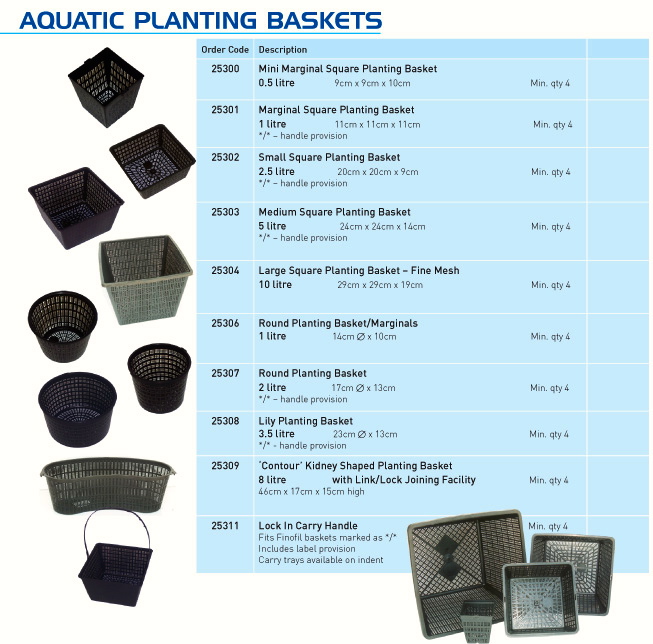
 I am planning on a 4' X 8' X 2 baskets high system and would like to know a supplier that has good baskets?


Thank you in advance,

Bob


Make sure that what you buy in plant baskets looks like the baskets at bottom far right of this photo. Photo from internet.


Finding good planting baskets for the Biocenosis Baskets is really up to each hobbyist and the area they live in. I went to Home Depot Hardware store the other day and seen in their pond section the perfect planting baskets there.

The only advise I can give is check the internet or you local hardware store or garden center for a good deal on the baskets. I know that some of the mail order stores have them but check first too see if they are the right kind. Look at some photos first before you buy.Look at the Biocenosis baskets as giant magnets.


We had seen ponds that had whitish foam around the waterfalls and around some of the rocks near by. The bubbles that this foam made took a long time to pop, what is that foam from? Is it bad for the fish in our ponds?


Q:
My wife and I went on the pond tour; we had seen ponds that had whitish foam around the waterfalls and around some of the rocks nearby. The bubbles that this foam made took a long time to pop, what is that foam from? Is it bad for the fish in our ponds?


A:
The foam is a mixture of oils, proteins, fats, and other organic compounds that accumulate in the pond water. Some of the foam will derive from your fish and from the decay of uneaten fish food and some comes from the breakdown of plant debris and algae.

The foam commonly found around the base of waterfalls, with the physical actions of churning water causes the substances to break out of the water column and coalesce as foam. If the majority of compounds that comprise the foam come from plant decay, and/or plant matter, the problem is unattractive but not that harmful to the fish. However, when the majority of the compounds originate from fish sources, it can become very hazardous to the animals in any aquatic system.

Studies have shown that fish kept in water polluted with fish-derived dissolved organic compounds suffer a higher rate of disease and parasitic infestations and do not grow as sound as fish kept in water with substantially lower concentrations of the substances. The concentration of these substances will also lower the redox potential of the pond waters and substantially decreases the ability for the water to carry oxygen.

Because there is no easy way to tell, whether the foam in a pond is fish-based or plant-based. The higher the fish load in the water body proper, the greater the likelihood that the substances will be fish-based, and are a potential cause of fish disease problems.

This is why some of the higher tech ponds will install a foam fractionator, which will remove the dissolved organic compounds from the water. Ozone may also be used as a supplement to the foam fractionator to help remove the organic pounds.

A normal molecule of oxygen (O2) has two atoms, and ozone (O3) has one additional atom. The extra atom is highly unstable and is an intense oxidizing agent. The main reason for its uses is to eliminate unwanted dissolve organic products by increasing the systems redox potential and applies to a sequence of chemical events in which elements and compounds transfer and/or rearrange positive and negative electrons. Elements and compounds that want to gain an electron are “reduction agents” and have a negative charge. Those that want to give up an electron are “oxidizing agents” and have a positive charge. Measuring the effectiveness of this process by its minute electrical charge it generates in millivolts (mV) with an Oxidation Reduction Potential meter (aka: ORP meter). We must also remember the effluent from an ozone contact chamber must be passed over a bed of activated carbon to remove residual ozone before it returns to the pond. Even though residue ozone is short live, usually less than an hour, the residue can damage fish tissues and other inhabitants of the pond plus reduce its natural fauna.

In addition, ozone does not add dissolve oxygen in the pond water, at least in any significant quantities that would benefit any of the pond inhabitants. Depending upon your pond husbandry practices, it is very possible to get by without it. However, before any hobbyists turns to its use, increasing dissolve oxygen in the pond by increasing water circulation, reducing bio-load, trying a more efficient and/or better designed filtration system, and increasing the ponds general maintenance level, seems to be preferred over ozone usage.

A disadvantage of the foam fractionators (aka: Proteins Skimmers) is that some beneficial organic and inorganic trace elements are also removed. So systems with efficient protein foam fractionators must be monitored for loss of these elements. This skimming process does not work as well in freshwater, due to the almost neutral pH, and this reduces the electrical interaction between organic molecules and water, which decreases foam fractionation. In addition, the lower density of freshwater reduces the formation and stability of tiny air bubbles (the addition of salt may be needed). The only time foam fractionation and ozone is to be used, is when the stability of the pond is in question.

A fractionator can be very beneficial to the pond, but it does not fit within the modus operandi of every pond enthusiast. It has to be cleaned, adjusted, and cared for on a daily or weekly basis, or else it will become useless.
Two different sizes of Clarity Protein Skimmers for pond use; not only are they big but also must be hidden from view somehow from onlookers. They are only necessary for those that have high organic waste from dead plants, over feeding, too many animals in ones pond, inadequate filtration and bad husbandry.  These two expensive protein skimmers will help cover-up ones mistakes but they will not correct what is wrong in the first place and are only a Band-Aid in pounding…not the cure!
Photo taken from Internet.


As I wrote this I decided to run outside and take a photo of my ponds waterfall -above two photos- to see if there was any protein bubbles…nope! That’s why my TDS, CE and Redox are so high in my pond because with proper husbandry and with the Anoxic filter I don’t have to worry about organic waste buildup. 


Anoxic Filtration System ®
February 02-2005-2013
New Updated Version

Thursday, August 22, 2013

BY: Tony Ruiz...To my surprise, he did not have the typical filtration system that we are all used to seeing, well in theory at least, he was using something different, not the kind of filtration system that is used in everyone else’s backyard ponds.


BY: Tony Ruiz


I have kept Koi and/or goldfish since 1986. Since then I have tried many types of filtration system, from bead filters to sand filters and a few other homemade filters I'd care not to talk about. Most of them helped keep the water clean, or did they? The biggest problem with most of these filters is the inadequate removal of harmful pollutants from the pond water... 

On the pond tour of 1999, I visited many beautiful ponds. I also met a professional Ichthyologist/Limnologist by the name of Dr. Kevin Novak. After looking at his pond and fish and seeing the success he was having, I was lucky enough to spend some time talking to Kevin about ponds and filtration systems. To my surprise, he did not have the typical filtration system that we are all used to seeing, well in theory at least, he was using something different, not the kind of filtration system that is used in everyone else’s backyard ponds. Either most pond keepers have part of their yard filled with all sorts of contraptions or they take up a two-car garage and turn it into a web of plumbing and filters. 

 I started to tell Kevin about some of my pond problems and it kept coming back to being filtration problems every time I brought up a new problem. I then told him: “If I had to take up half of my yard or my garage and fill it with contraptions to keep a healthy pond with Koi in it, then I would close down my pond down forever.” By this time desperation was setting in, my new Biofalls filter, and all the other things including chemicals were not working, they were only compounding to my problems. 

To my surprise, he said: You do not need all those contraptions and expensive chemicals to have a healthy pond with Koi in it. At first, I was hesitant and I said to myself: “Here comes the sales pitch!” Kevin started to explain to me how his Anoxic Filtration System works and my first impression was that now, he would be telling me the name of his company and/or store and then be telling me he could build a filtration system just for me and this would have a hefty price tag connected to it. However, this was not the case! He went on telling me about how easy it was and inexpensive it was with his filtration system and how the Anoxic Filtration System works. For the cost of a few water lilies, planting baskets, and Laterite plus cat litter all placed in a separate area called a filtering pond you to you can have a healthy and easy to maintain Koi pond or Water Garden. 

After carefully examining Kevin’s pond my first impression was; “Sure this is a small pond of about a thousand gallons with big Koi in it, but, can this system work on a much larger scale pond of let’s say, a 7000 gallon pond or more!” To my surprise, the answer was unanimously yes; it will work on any size pond. By this time I was ready to try anything after all I was desperate. I was tired of spending money on fish and chemicals and other things that just kept adding to my problems, not to mention emptying my wallet very fast and the bad advice I was getting from everyone else. 

 Building the filter that holds the plants is not really that difficult, he said! The first thing you have the do when you are going to build this filter which can be just about any size or shape you may wish it to be, as long as it’s cable of holding all the pots you will need, and remember that it must be at least 24 inches deep our deeper. This will ensure that there will be at least two cubic feet of water for every square foot of pond surface area. As I was told, this offers the most stable water conditions and makes controlling of any suspended algae easier. 

The minimum number of pots for a small pond would be about 15 of them and at least five of those would have to be with plants in them. Of course, you can plant all 15 of the pots with plants in them; by doing this, you would only enhance the filtration system. I was also told that the filtration system could have more water flowed through it than other types of filtration systems can. The faster you can get water from the main-pond to the filtering pond, the better the filter will actually work. {Ed: Once again plants are an option, but an empty Anoxic filter is so drab.] 

You see the filter is not dependent upon water flowing through the filtering material itself. Most filters that I have had, in fact all the filters that I have had, depended on how much water can flow through the filtering medium itself. That if water flows too fast through the filtering material, that this would be detrimental to a filters capability of filtering and breaking down waist products in the pond. I also found out, that the bacteria, in filters that have water running too fast through them would actually not perform at their peak performance. Because the bacteria must resist water shear and that if water flows too slowly, the filter will become very inefficient at breaking down waste products. This is because the bacteria that we need in our ponds, needs so much oxygen to carry out any biological process and therefore will actually begin to die off. 

 I n this Anoxic filter, water is never forced through the substrate, but a slow steady diffusion by electrical charges moves water through the substrate and it therefore would not clog. I also found out that when people build these particular kinds of filters that they needed stronger pond pumps and that was only because now the filter can handle more gallons per hour than the old filters, which they were using. This means that the pond must be able to turn over the pond volume of water at minimum once per hour. The only downside of pumping so much water through the filter is that it is necessary to defuse the water in the main filtering pond. This is because you do not want water stirring up of any of the organic matter or settlement inside the filtering area. [Ed: The better your pre-filter the less mulm/settlement you will have.] 

The filter actually acts as a big settlement chamber that allows any dead algae, detritus, or any dirt to be collected in it, that the pre-filter and/or skimmer doesn’t get before entering the filtering pond. Therefore, defusing the ponds pumps output is of the highest priority when using the Anoxic Filtration System.

I was faced with the problem of finding a separate area to build the pond for the Anoxic Filtration System. Having the space became no problem because at my new house my pond was built above ground with retaining wall blocks. I added a 4’x9’x3’ foot deep edition to my 65’ long pond. To this area, I added my water lilies, planted in Kitty litter. I also added Laterite, which came in the form of iron tabs to help the plant growth.[Ed: Laterite is no longer sold as tabs but only sold in its clay form in a box.] 

No nitrogen tablets at all were to be used in the setting up process, for this would do more harm than good, this was the instruction I was told. To this I pumped about 8,000-gph of diffused water through this system and in two weeks; I had clean clear water, and the fish started looking great. Thanks to this Midwest Pond and Koi Society member, that was willing to help and share his knowledge with me and on top of that, never charge for his help. That I became very successful in pond keeping. That’s correct, all this help was free! For the cost of few baskets and some Laterite, I became the expert that I am. 

It has now been 13 years with the Anoxic Filtration System and now I have healthy fish that are growing at an alarming rate and water quality that only most pond keepers can only dream of. Thanks to Kevin Novak for caring enough about my problems and about this hobby to share with others, his knowledge and expertise advice on microbiology and pond husbandry. Definitely, people must start thinking out of the box, the filter box that is. If you wish to see more photograph of my pond, you can go to my web site at www.yorkshirecanary.com and look for yourself at my success. However, if you see a fellow smiling from ear to ear in the photographs, well that will be me.  


This was Tony’s 65' pond 13 years ago. He liked the Anoxic Filter so much he incorporated it into his new pond, too.


Now tell me…can anyone tell this is an Anoxic Filter? I’m looking right at it and I still don’t see it! I count 19 Water lily flowers in this one photo…and all without any fertilizer tabs to degrade water parameters. Now this is something to wakeup to every morning looking out on the veranda.


Top two photos are of Tony’s new pond and Anoxic Filter. Pond and filter in one photo without the unsightly equipment and cost of an expensive filtration system.


Wednesday, August 21, 2013

What exactly is redox and how does it pertain to pond owners? Why is it so important?


Q:
I read in your article about redox. What exactly is redox and how does it pertain to pond owners? Why is it so important?

A:
Redox potential is the oxidation-reduction reaction, which is a valuable indicator of the status of the life supporting capacities of a pond ecosystem. Very few pond hobbyists measure redox potential, but for the serious pond owners, they have used this particular technology far years. To understand redox potential we have to simplistically refer to atoms and electrons. Atoms are small packets of matter compose of positively charge protons and neutral neutrons that form a nucleus. Negatively charged electrons surround the nucleus, and distributed, in “shells” at various distances or energy levels from the nucleus. The more protons and neutrons there are, the heavier the element will become. Elements interact with each other in different ways mainly by sharing the electrons in their outer shells, thus joining, and forming various types of molecules that compose compounds with different physical and chemical properties.

The usages of the term “redox” in the language of chemistry is a contraction for “reductionoxidation reaction” and “potential” refers to electrical charge on a molecule that’s been formed in a reduction-oxidation chemical reaction and is dissolved in an aqueous solution. Combining two elements in a reduction-oxidation reaction, one is said to be oxidized and the other is reduced. Therefore any chemical process that includes either a partial or complete transfer of electrons is and oxidation-reduction reactions. Oxidation means the apparent loss of electrons by a molecule or atom and reduction means an apparent gain of electrons. Electrons are not lost or gained in these reactions, the atoms only changed the way they share the electrons of their outer shells.

Whenever elements are oxidized, another element must be reduced. If a molecule is a product of oxidation, it has a positive electrical charge or potential, a cation. The molecule that is a production of reduction has a negative electrical potential, an anion. The redox potential of a pond is a measurement of the relative amount of the positive and negative charges on the oxidized and reduced molecules that are present. Oxygen is one of the most important single oxidizing agents; the presence of free oxygen will always keep the redox potential in the positive range. A negative redox potential only occurs without free oxygen.

However, the accumulation of reduced molecules (the result of the addition of organic matter) will diminish the redox potential, even if oxygen is at the saturation levels. The most widely used method of measuring redox potential is with a platinum indicator electrode immersed in the pond against a reference electrode of calomel or silver chloride. The results are measured and/or expressed in millivolts by using a meter or a redox potential controller. The redox potential of a hobbyists pond should range between 200 and 350 millivolts. Lower levels than 150-200 indicate an unacceptable accumulation of poisonous, reduced organic compounds. Levels of 400-450 millivolts indicate too active oxidizing environment, which can possible damage the delicate aquatic plants and animals’ tissue and cells. Redox potential can have an influence on the growth of algae at various millivolt levels in our ponds.

The higher the oxidative states, the higher the redox potential, this means no pollution to very minute amounts are present in solution, and the water must be of excellent quality. That is exactly what every pond owners is trying to achieve. Another way to express the quality of pond water is by its rH2 number. This is generally considered more accurate than the redox potential itself because it considers more factors. Water that has a neutral oxidation-reduction activity has an rH2 of 21. Water that has more oxidative potential has an rH2 over 21, and when reduction prevails, the rH2 will be lower than 21. No meter measures rH2 directly. It is a number that you have to calculate, by determining both the pH and the redox potential accurately; then by using those numbers given in the formula below.

rH2 = Redox potential / 29 + (2 x the pH).

For instance at a redox potential of 250 mV, and a pH of 7.4, the rH2 index would be 23.4, or definitely in the oxidative area, and not in the reductive area. All this is another tool, and another way of determining at how well your pond is doing. Therefore, it is helpful in describing the water characteristic of a biomass. At this level, you should not have any problems with micro-algae and/or Blue-green algae, but to attain this kind of number, both your nitrates and phosphate levels must be extremely low, and well within the recommendations, which I have given.

Since 80 percent of all fish deaths and diseases are related to poor water quality, knowing the redox potential and/or the rH2 levels of the pond will tell you a lot about the extents of the animal’s environment. This will also alert you in taking and evasive course of action in fixing and/or eradicating the problem that otherwise would be unknown to the hobbyists. As the old saying goes, "And ounce of prevention is worth a pound of cure!”


Professional Oxidation Reduction Potential (ORP) monitor 
Photo by: Doctors Foster and Smith


Tuesday, August 20, 2013

Nexus are over rated and k1 is in fact not that good when it comes to dealing with large amounts of waste.


Hi everyone, 

I have been running my Nexus 200 and nexus easy pod for around 3 years now, and this is the first year I have had a good run with feeding regular amounts throughout the day, due to the high temps we have had for a change compared to the last 3 years or so! 


Now the problem is my nitrite which I have mentioned before, it has hardly been 0.0 all year and tends to hang around 0.25 to 0.5, I backwash every 3 days and top up with purified water when I do this, I have spoken to a couple of dealers regarding this and they seem to think Nexus are over rated and k1 is in fact not that good when it comes to dealing with large amounts of waste, they seem to think the surface area of k1 is not large enough for large amounts of nitrifying bugs to accumulate on.


I was thinking of adding a trickle tower to try and smooth out the problem, but one dealer said not to waste my money and change the k1 to a new filter media he has brought out that has 6 times the surface area compared to k1, he told me to wait until the winter to change over the media when it will not stress out the Koi as much, I’m kind of confused on what to do any suggestions? And have you heard something similar regarding Nexus and Nitrite problems?


Regards,


Steve


Also on the same forum...

My nexus 310 is in its third year, and has been great, with readings good and clarity acceptable. This year I raised the temps and increased feeding to 6-7 times a day. The nexus has let me down big time, nitrite is low but never gets to zero, but he worst aspect has been the water clarity, from lovely clear water at the beginning of June, to water so cloudy, I cannot see the bottom.

At the moment I am putting floss in the exit chamber to try and clear the water, but it is blocking after only six hours.

There's not much else I can do at present, but next year may be expensive, as I have to rethink my entire filter system.

Mark


This is the inside of a Nexus 310 filter…see the bacteria’s polymeric adhesive on the K1 plastic medium turn brown from detritus.


 This is a question being asked on a Koi forum. As expensive as these filters are: Don't you think after being out since 1985 that all the problems would've been ironed out by now? We the hobbyists are not the Beta testers of manufactures! It just is very disappointing to read that after 28-years these filters should run like clockwork with no problems at all to the hobbyist. This is exactly what happens when research and development is not done like I did on the Anoxic filtration system. The only difference is; a Nexus filtration system here in the U.S.A. will could cost you, as much as $5000 by the time you get all the add-ons you need. 


This is exactly why I went through so much trouble with R&D and making this system of mine work and did all the testing on it for years before it was brought out to the public Too many hobbyists out there that are new to the hobby, buy filtration systems that don't quite work as advertised and then they are stuck with them. I remember one woman telling me, "I wish I would've known about your filtration system before I bought mine, but now I must make mine work because I paid so much for it!"  


Surface area! No matter how expensive or efficient a filter is the total surface area of your medium needs to exceed that of the available foodstuff for the metabolizing bacteria to live on. This is why small filters always run into problems if the hobbyist does not have enough foresight on how big the future growth of their animals will be and food consumption those same animals will eat and their byproducts. We haven’t even touched on unforeseen insults, like example when the Raccoons emptied the automatic food dispenser into my pond. It’s better to have too much filtration than not enough.


The hobbyist above got away with not having a large enough filter because of cooler temperatures and the slower metabolic rate (BMR) of his Koi. But once the ponds temperatures began to elevate to those of warmer climate ponds (Like we have here in the Midwest of the U.S. where pond temps can get + 80F°-26.7C°) then the accelerated metabolic rate of the Koi and the amount of available food given exceeded that of the filters capacity to neutralize those insults; this also happens when filter begin to clog. So don’t expect miracles from pond filtration systems that have a small footprint. A 24”- 60.96cm Koi can eat 183-grams of food a day. That would be about 6% of its body weight which is the same weight as a 10” Koi that weighs 8oz.-226.79g. and/or 3.5 lbs. - 1.58kg of food a week! 


Anoxic Filtration System ®
February 02-2005-2013
New Updated Version

Greg’s anoxic filtration questions:


Greg’s anoxic filtration questions:
I use to have a couple of cases of plant baskets and gave them away ... dang.

OK, I have read every page of material and have some questions. Some are design questions, alternate configurations ideas, etc.:


Q: "Each biocenosis-basket in the Anoxic Filtration System acts the same way. Ammonium ions checks in, but they will never check out"
What happens to the Ammonium ions in the baskets without plants? Does absorption stop or reach saturation at some point? Is there a rating on each pot as to how many grams or measurement it can absorb? I’m thinking like Activated Carbon here. Doesn't it have to be recharged somehow without a plant?

A: Each biocenosis clarification basket without plants is a microbial and chemical sink unto itself. First, Nitrosomonas bacteria and/or facultative anaerobic heterotrophic bacteria consume ammonia and/or ammonium or as some people like to call it Ammonia-Nitrogen (TAN) that is attracted inside the baskets and all other positive ions that are taken out of solution (that can become an available foodstuff for the bacteria), too. Yes, facultative bacteria can and will convert toxic ammonia and/or ammonium into nitrites then again into nitrate, then again in Dinitrogen N. Therefore, even if the Nitrosomonas and Nitrobacter do make toxic ammonia into nitrates, like in other filtration systems they (nitrates) also will be consumed by the facultative bacteria for their carbon needs. Saturation is literally unachievable, because all bacteria will increase or decrease depending on the available foodstuff and that of microbial living space. In astronomical terms, the number of facultative bacteria is quite unbelievable especially in elevated temperatures per mm of space. In colder temperatures, these dimorphic bacteria will be the domination bacteria too, helping your Koi come out of their lethargic state after a long winters rest. In other words, it’s a win, win situation with this bacteria unlike Nitrosomonas and Nitrobacter that is useless at temperatures below 55o F (12o C)1.

I can see what you mean by activated carbon and becoming exhausted when its pores are filled. However, each biocenosis basket does not act and does not have the same structure as activated- carbon. The key words here for the kitty litter and Laterite are permeability and porewater capabilities. You must also remember that heterotrophic bacteria are the most abundant bacteria in all ponds, whether natural or otherwise. Even in a brand new system, (like a new pond) heterotrophic bacteria are still in abundance and will start converting hydrocarbons into very toxic ammonia; they never have to be reinoculated and/or inoculated into the system like Nitrosomonas and Nitrobacter. Tests have shown that the baskets themselves remain open to microbial and biochemical mediators or processes for years (18-years for some of my baskets) without clogging like conventional filtration system do. I would recommend adding Laterite every ten years or so, just to help bacterial colonies grow better, faster and to replace trace elements, for it (Laterite) may become too exhausted and become useless. Some hobbyists run this system devoid of plants altogether, in dark garages. Remember this is not a veggie filter or bog filtration system like some people think, this is an anoxic system, and it is not plant reliant like those other systems are. Geographical location of the filtration system is also not as stringent as those veggie filters.

Q: Wouldn't the 2 cubic feet of bio-balls use as a diffusion tool harbor the bacterium that converts ammonia to nitrite to nitrate? Especially since they are getting the water before the plant baskets? I would think that with the way the Anoxic system works you would want as little surface area for nitrification as possible.

A: Yes, the bio-balls or whatever medium you use (example: Matala filtration media) for a diffusion system, will convert some of the ammonia into nitrite then nitrates. However, this is something you really can’t avoid. You have to diffuse the water somehow and this is just one way of “skinning the cat” as they say. If you think about it Greg, all over the pond and on your animals this process is unconsciously happening and it’s unstoppable. It is part of the transformation of events that balances out the chemolithotrophic bacterial processes and the anoxic processes. Good thing is; you’re using the biocenosis clarification basket to get rid of the excessive Nitrogen (nitrates) in the system. One bacterium makes it and the other bacterium takes it away, as to say.

Q: Do the baskets need to be in deep water, or will shallow water work just as well? Need shallow water for Iris, Sweet Flag, etc. Otherwise Lilies would be the only plant you could grow?

A: Shallow water will work just fine; only the stability of such will be questionable (temperature change and such). Let’s say you have a 14” deep stream and you placed biocenosis basket in it end to end, this would still work. In fact, it would be great! Picture this if you will. A stream with numerous filtration baskets, some with plants for cosmetic purposes (or all, that’s up to you) and some without, not a bog or veggie filter but a long anoxic filter. Yes, you could use Iris, Sweet flag, Rush, and such. All aquatic plants require the same ammonia and/or ammonium for proteins. Liliaceous will do better in a deeper anoxic system of two feet or more.

Another problem is; that your plants will grow like banshees and you would be cursing me out by years end. You would not believe how efficiently your plants will work for you growing them this way. It is not unusual for the plants to grow roots outside the baskets by years end. Another problem is; you would have to stop the stream twice a year for clean-out! You would have to have a devise that in someway would block the stream somehow, so during clean-out no detritus and mulm would go into the main pond system and contaminate it.

Q: Wouldn't smaller baskets have easier absorption than larger ones or is there a minimum size for it to occur? I’m wondering if some kind of tubes or fabric can be used, picture in your head rolling cigars.

A: That’s a good question, but the baskets, they work off of an electrical charge and diffusion, and a circulatory movement like convection, absorption is not a primary movement of foodstuffs when void of plants. Some hobbyist will use smaller baskets, but that is only for weight purposes not so much so for efficiency of the filtration system. However, you brought up about using tubes. I never thought of that myself, so I can’t say if it would work! It sounds good in theory but then again all theories must be proven out, to become factual.

Q: Would a shallow layer of Kitty litter in a deep stream also work? Say my 14" deep stream, 50' long by 4' wide with 8,000-gph flowing through it. Right now the bottom is lined with golf-ball sized rocks. What would be the effect if I removed the rocks and put down a 3" layer of kitty littler for the plants to grow in? One reason I went to the "soilless" planting method was so the plant roots would get their nutrients directly from the water. Which works great as you can see from the plants growing in my stream, however it does nothing for the Ion attraction. Plants using Nitrate instead of Ammonium as you mention.

A: I can tell you right now the golf ball size rocks are giving you a redox problem right off the bat. It will also cause turbidity problems by causing green algae blooms and/or cyanobacteria problems (blue-green algae). Placing Kitty litter directly on the bottom is a definite no, no. You will be cutting off the intersection of topography as to say (water going in and out of the kitty litter freely, without hindrance) and the system will collapse in a very short time. The Kitty litter that will be sitting on the bottom of the liner will go obligatory anaerobic in a few days and begin to make more ammonia and/ or ammonium and Nitrates that will go back into solution. This is extremely important because ammonium can be recycled in the filter back to nitrate and either or both nitrate and ammonium can diffuse throughout the Kitty litter and Laterite, creating an extremely nutrient-rich filter environment. This is exactly what is happening now with the set up you have. That is one reason your water is staying so green late in the year. If you do as I said in the top question, you definitely would see an improvement in redox and water clarity. What you have now is no better than an Aquascape’s (I hope I spelled that right) filtration system. Look in the CD-book at page-55, I tell all about such filtration systems. By placing your plants in biocenosis clarification baskets like those that I explained in my CD-book, you will see a big difference in plant growth and redox. Remember Greg, getting ammonium and/or ammonia out of the picture before autotrophs can break it down into nitrates will help. Plants like; ammonia not nitrates and will only take nitrates when ammonia is exhausted or near exhaustion.

Q: The plants potted in the baskets get to use the Ammonium...Does that mean the water hyacinths are using Nitrate directly?

A: 75-percent of Water hyacinths – Richornia crassipes and Pistia stratiotes, Water lettuce-uptake is Nitrogen and 25-percent is ammonium. This is one plant, which is an exception to the rule. You must remember that the Liebig Minimum Law governs all aquatic plants and nutrient uptake is governed by that element, which is at a minimum. Cations and Anion must be taken in equal amounts in order avoid a fatal pH swing. Most of the time, Iron seems to be the element that is constantly at a minimum in all ponds except natural systems. Most aquatic plants, work nowhere at peek efficiency with other ways of planting.

Q: Is there a way to get the Ammonium to check out so that floating plants could take advantage of it? Basically asking if there is a different way to do the conversion?

A: You want ammonia to go back in solution and then have plants absorb it? You do not want ammonia and/or ammonium to stay in bulk water any longer than it has to. Aquatic plants are fast but not fast enough for our Koi’s sake. That is why with the Anoxic Filtration System you try to move as much water as possible through the filtration system. The electrical charge is far more efficient attracting the ammonia ion out of bulk water, than ammonia and/or ammonium uptake from plants.

Q: It should be possible to create this anoxic system where in the water is gravity fed through the system, and the pump pumps it up to a waterfall, correct?

A: Yes, you are correct in that assumption.

Q: Would it be possible to create this anoxic system right in the main pond itself? Why the separate chamber? If a pond had a good turnover rate and pots of lilies all over planted in the material, wouldn't the same effect be gained? I’m thinking back to a few years ago when I actually did have kitty litter and lilies in my main pond and my pond seemed healthier? Could I have had an Anoxic system back then and inadvertently removed it?

A: Yes and no, yes, if you made an island and the filtration system was in middle of the island. No, because you would turn you whole pond into a big filter. This filtration system will grow and contain cyanobacteria in it, but the main bulk water should stay free and clear of such. The way I look at it; it’s better to have cyanobacteria in the filter than in ones pond, wouldn’t you agree? Soon as the filtration system starts running at full capacity, the cyanobacteria will subside like magic. In another words, the filter will starve the cyanobacteria out of available foodstuffs. Cyanobacteria are very pragmatic for many hobbyists and this filtration system helps control such but does not eliminate it completely as explained on page-50 of my CD-book. That is why the waterfalls in the pictures, in the CD-book stay and look cleaner than convention filtration system. Containment is the key word here; do not let available foodstuffs (like phosphates) back into bulk water as other system do and does not let nutrient-rich waters (Ammonia-Nitrogen) back into solution ether.

Yes, you almost had an Anoxic Filtration System; but you were missing a key ingredient like Laterite and the open cell baskets, and yes, you unintentionally destroyed it. You planted up your plants with golf ball rocks instead of ammonia attracting kitty litter. The rocks no long attracted the ammonium ion, and your plants, yet looking good, were now doing less work cleaning your pond than before. The anaerobic bacteria at the bottom of your veggie filter in now making its own foodstuffs, like ammonia and nitrates by Assimilatory Denitrification. You’re probably kicking yourself in the butt right now aren’t you?

Q: "that anaerobic conditions will convert nitrogen into a gas element."
Are the bubbles that can be found coming off the pond liner in areas of the pond with poor circulation Hydrogen cyanide?

A: Man, do I love these questions you’re giving me; it shows me you’re on top of things and thinking. The little bubbles (aka: “pearl bubbles” in aquatic botany) are oxygen bubbles from photosynthesizing algae. These bubbles will only form when oxygen is at its peak, or at saturation point of a given temperature. In fact, there is no better way to add oxygen to water-except through an oxygen reactor- which will impregnate water as well as photosynthesizing plants do. That’s why Anacharis gigantea, Cabomba caroliniana and Ceratophyllum demersum plants are all call “oxygenater-plants. You can see the small pearl bubbles coming from the leaves if the water is still enough. In fast moving waters these bubble will usually go unnoticed.

Q: Is Cyanobacteria the cause of hair algae? By eliminating it, I can solve my algae problems? I have tried Barley Straw and Hydrogen Peroxide, they work for a time but it comes back. I say treat the problem not the symptom.

A: Cyanobacteria –AKA: blue-green algae-are the same. Blue-green algae are only classified that way by botanist, but in actuality, it is bacteria, that can make its own foodstuff at its base. Eliminating cyanobacteria is easier said than done. My CD-book tells why.
Okay, the plant filter you are using now is your biggest downfall in fighting cyanobacteria. It is literally a huge chemical sync, and its allowing Nitrates, phosphorus, and phosphates to be dumped back into the main bulk water. You are adding fuel to the fire as to say, those golf ball rocks are beginning too clog and they are now making Nitrates and ammonia. No wonder your plants look so great, you’re feeding them all kinds of food and you didn’t even realize it! Your plants are doing very little work to keep and maintain water clarity. Instead of helping you take ammonia and/or ammonium out of the system, it’s seeing the available nutrients from your gravel and not your pond.
Greg, whatever you do please change your way of thinking, your fish are great, and they deserver better water quality than what you’re giving them. This really makes me mad, that some village-idiot told you to do this, they should have known better.

Q: Doesn't plant roots eventually plug up the kitty litter baskets?

A: If you have that many roots in a basket, you can bet that the plant has done its job for you a thousand fold. It’s telling you: “time for a transplant please!” When a plant becomes root-bound, it then will become stunted, and each exceeding year will get smaller and smaller until its vascular system shuts down and dies. To answer your question: No it does not affect the kitty litter in the slightest; it keeps attracting the positive ions out of your system as it did from day one.

Q: "This settlement will stay undisturbed between the biocenosis-baskets until a later date when it can be disposed of." "Mulm, which is a matter left over after total mineralization has taken place, is inert, and does not affect the water quality any longer" How do I tell the difference between Mulm and Poop? How often is this dumped? Wouldn't bacteria be at work in this sludge? I dumped my filter pit last night; I was ankle deep in a 4x8 pit of brown sludge. Full of leeches, bloodworms, snails, etc.

A: I’m very pragmatic about really good too excellent pre-filter before any filtration system. It is paramount in keeping any filtration system clean and healthy. I cannot emphasize this one thing to the hobbyists any stronger if I tried. A good pre-filter will cut down on considerable amounts of fish waste, food, algae, and plant matter. It has been proven in saltwater system that cleaning the pre-filter before filtration takes place will keep redox at its highest point with very little outlay. It is no different in our ponds; it has been scientifically proven that; filters stay cleaner and healthier with good pre- filtration. The key word here is: healthier. What makes it through the pre-filter, which is organic matter, now, will settle and mineralization will take place by the microbial flora. As you know this then become ammonia and/or ammonium and must be taken care of by the filtration system. Think of this; the ammonia ion (DOC) is being made in the filtration system were the biocenosis clarification baskets can immediately take care of it as positive ions, plus any negative ions that cross the electrical gradient by diffusion. The thing you must remember about this system in opposition to other systems. The baskets themselves are a constituent of the filtration system inner workings, but not the filtration system itself. However, as it (detritus) keeps breaking down it them becomes mulm.

With the Anoxic systems set up the way I say to set it up in my CD-book, this detritus/mulm and don’t forget smuts too, will not compact as greatly as a conventional filtration system does. Remember all this is not being forced into a filtering material as such. This is exactly what happen in a natural system, and guess what, this layer of detritus become negatively charge just like the baskets are. This then will also attract the positive ions and do the same things as the baskets do. Nevertheless, as we all know this settlement must be taken care of eventually, and that is why I highly recommend at least two filter clean-outs a year.

1: Nitrosomonas can become dormant when starved of ammonia under otherwise ideal environmental conditions. They also have the ability to go dormant in cold-water conditions. However, both Nitrosomonas and Nitrobacter will still be working in the wintertime to some degree, and that degree is contingent upon the condition of the filtration system, its size, and available foodstuff. I understand we like to compare our pond filtration systems to sewage treatment facilities. Nevertheless, our filtration systems are dwarf by comparison, to such high-tech-systems.

Nitrobacter do not have this ability to enter a dormant state when starved of their energy sources (e.g., nitrite). When starved, they die. This inability to become dormant, coupled with the inability to produce spores and survive oxygen deprivation, has special importance to the pond hobbyist.

While Nitrobacter can derive all the energy they require from the oxidation of nitrite into nitrate, they will use other sources if available. They can oxidize complex hydrocarbons just like the more common Heterotrophic bacteria; Nitrosomonas cannot, and are dependent on ammonia only. This ability explains why Nitrobacter did not evolve the ability to become dormant.

We as hobbyist must also must remember that in the wintertime most filtration system are closed down, shut off from all available foodstuffs, and oxygen deprivation will take care of (killing off) altogether our beneficial bacteria. The only surviving bacteria will be that which is left in the ponds bulk water. However, these bacteria will now be in very limited supply, only because of lack of available surface area that the filtration system itself provided.

Some hobbyist will clean their filtration systems in early spring without the inoculation of such bacteria. Their system will seem to take forever to become fully active, do to the cold water conditions alone can hinder this cycling. Now you must add on your animal load and the ammonium that is being produced by feeding, along with their increased metabolic rate. Koi can (and will) feed in such cold temperatures. Algae and available plant matter will be their fist food sources. I live in Chicago were the weather here is very erratic during this time of the year. It is not unusual for my fish to be feeding once or twice a day, do to their increased activity once the filter is back on line.

That is why with the Anoxic Filtration System you start it when the weather breaks, as long as freezing will not hinder your outlet from the filter to pond. This is typically in late winter or sooner if possible. That is because the biocenosis-clarification-baskets and any plants you my have are already working taking in the ammonium ions out of bulk water. Why other systems are barely on line, this system is already taking in ammonium ions for Heterotrophic bacteria and for Nitrobacter and Nitrosomonas. Oxygen is never exhausted when the filtration system is shut down for the winter because of anion producer such as microbial and/or aggregate produce enough oxygen to engage or attract the carbon dioxide and that will move cations, releasing the oxygen and consequently making the baskets more aerobic. As long as the baskets stay aerobic to some degree, that will hinder the production of obligatory anaerobic bacteria.

I know what I have just said is not really anything news breaking, but I don’t understand why we forsaken such technology for the latter? After all, you can buy a bag of WalMart Kitty litter for about two bucks. It comes in a red and black bag of plain cat litter, no additives, and just plain clay. (Only use clay –Attapulgite-that has been mined from the earth, clean, baked, and pulverized such as Kitty litter.)
I will also add right now that the footprint of the Anoxic filter is not small. This is done for a purpose. Imitation sewage treatment facilities and/or a car engine: There is no substitution for cubic inches when it comes to filtration systems or horsepower.