Saturday, October 3, 2015

I saw that you put the Picture of my test results on your blog so I thought that I had better give you a few more details about my pond build.

Hi Kevin,

Yes I have read every single article on your blog and everything on Manky Sanke’s too. http://anoxicfiltrationsystem.blogspot.com/2014/12/well-long-anticipated-informative.html

I saw that you put the Picture of my test results on your blog so I thought that I had better give you a few more details about my pond build.

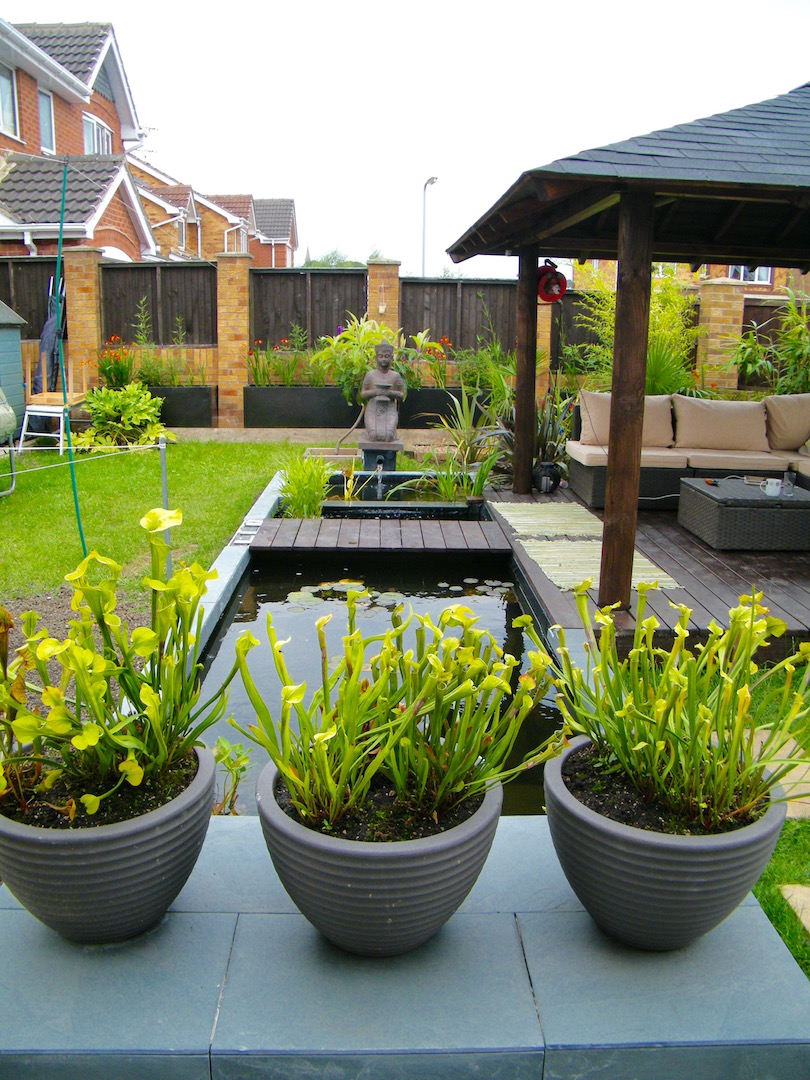
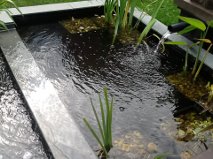
It is divided into two sections. The Main pond is 4.5m x 1.5m ranging from 30cm deep to 65cm at the deepest (very small area where pump is) and the Anoxic filter pond is 90cm x 1.5m and is all 60cm deep.

It holds 3414l and I am running a 4500lph pump to a black box filter (Pre Filter) with an 11W U.V. The pump is rated at 3950lph for the head pressure that I have.

I have 30 Shubunkins and Comets about 3inches in size, a few maybe 4-5inches.

We started building the pond at the beginning of summer this year and reused the existing (already biologically seeded) black box filter that I have had running for 2 summers now as a prefilter. All media and sponges were just rinsed out in pond water at the beginning of May and I haven’t touched it since, not once. I had already started some BCB’s seeding in my stock tanks in April so that they would be ready when the new pond was built.

In the Anoxic filter area I have an egg crate plenum grid sitting on some lengths of waste pipe to keep the bottom layer of 15 baskets off the base. This area was designed to take 3 rows of 5 baskets (27cm square) with an inch gap between each. Then there is another egg crate layer on top and a further layer of biocenosis clarification baskets containing plants sitting on top. At the moment I have about 7 baskets with plants in them but plan to add another 8 to make a second layer of 15 next year. (Pond building is a very costly business you know) I could not obtain any Laterite so the baskets with plants have one Cup of JBL Aquabasis plus in each. There are a further 6 water lily biocenosis clarification baskets in the main pond.

Some of the plant baskets that I took out of my old stock tanks had a thick layer of Cyanobacteria on them but this disappeared and did not proliferate in the newly set up pond (to my pleasant surprise)(yes I read your article about cyanobacteria hence the surprise)

The pond is in full sun facing south all day but despite this I have only a very small amount of blanket weed along the south facing wall and attached to the pipes and cables. The fish seemed to find it tasty so I have left it alone and it is now disappearing along with the sun.

I have had no green water, murky or cloudy water. I have done no water changes at all only topping up evaporation loss. pH  is now 8.00

The only slight disappointment that I have had this year is I have not had very much plant growth despite adding two rounds of pond plant fertilizer. After seeing Brian’s I was hoping to have an explosion of greenery. Maybe it is down to dividing and repotting my water lilies, which were happily sitting in aquatic compost baskets into BCB’s. Perhaps they don’t like root disturbance and they have had to grow new roots. Or I am wondering if this is down to the fact that my Nitrites and Nitrates have been more or less zero all summer. All the plants have been disappointing. Pontederia, Iris’s, Saggittaria, Elodea died, water hawthorn turned black.  Perhaps the fish are just not producing enough waste to feed the plants (or the BCB’s have gobbled it all up). I would like to know your thoughts on that please. It has not been a very hot summer here even by English standards.

I will be adding more fish next year. Based on one BCB per full-grown koi, how many full-grown 12” Shubunkins do you think 30 BCB’s can support?

Photographs to follow.

Thank you for your hard work and selfless nature Kevin.

Kindest regards

Rachel
Nottingham, U.K

Answer to Rachel questions:

The plants may have been a disappointment this year because they may have to relearn how to absorb and adsorb ions like they are expected to.
It’s not something I would worry about, next year will bring better plant growth once their root systems are established. The cooler weather will also play a big part in plant growth too.

 I know hear in Chicagoland all our terrestrial plants did great in early Spring because of all the rain we had and bloomed very early this year, but died way too early also but ran out of steam earlier than they were supposed to.

Thirty BCB’S can handle about 60-70 12" Shubunkins but I don’t think that many fish would be very practical though.


Kevin

 Anoxicfiltrationsystem.blogspot.com


Tuesday, September 22, 2015

Yep The Anoxic Filtration System Works…

Yep The Anoxic Filtration System Works…


pH      8.00
Nitrite 0.0
Nitrate 0.0

Happy bunny. Thank you.
Rachel
from the UK

Hi Rachel,
Did you manage to get read my blog? The Blog has a lot more info on it than the book plus some good reading from an author in the UK Syd.
Some of the best ponds I have seen didn’t have Koi in them but Goldfish; so there is a lot to be said about Goldfish, they’re very much underrated pets.

Yes, long ago many disbelievers were out there on forums thought they knew more about filtration than us scientist, but they were wrong!  Some just like to think they are better than others so I always ask: Why don’t you invent a better filter and bring it out to the public for scrutiny? But they don’t, because they don’t know how to.

It is not easy getting the word out to hobbyist on anything new unless you’re a manufacture of merchandise and can advertise those goods. You’re also right in saying that there is always the hobbyist that says: If you didn’t spend as much as me, then your filter is garbage attitude. However, with what is known today, spending more does not mean better, just that you’ve spent more to do it a different way that’s all.


Kevin

Friday, September 11, 2015

For a comprehensive look into the Anoxic Filtration System.

For a comprehensive look into the Anoxic Filtration System.

In case you have missed reading any articles or books on the Anoxic Filtration System just click on the links below and they will take you there. Manky from the UK has provided everyone with these easy access links.


As far as I know, the only article about anoxic filtration that was ever published in Koi magazine was the initial one that I wrote in 2008 about reducing nitrate, which introduced the idea of anoxic filtration but only had a brief description of the system. It has been republished on my website here.

If you meant Koi Carp magazine, in 2009 I wrote a more descriptive two-part article for Koi Carp and that also is now on my site.

This year, (after many promises and delays), I finally wrote the most complete description of the system and published it on my site here.

At the end of the article, in the acknowledgements, there are links to Kevin Novak's book, which can be downloaded, for free from iTunes and to Kevin's blog where he gives useful information and answers questions about the system.

If your eyes still aren't bleeding after reading that lot and you want to read the real life experiences of those who have built the system, you can search on this forum for anoxic and you will find many threads over the past couple of years.
__________________


Monday, September 7, 2015

This is just a small excerpt from a forum found in Bosnia on the Internet that is talking about the Anoxic Filtration System.

This is just a small excerpt from a forum found in Bosnia on the Internet that is talking about the Anoxic Filtration System.


You really wouldn’t expect Bosnia of all countries  to have Koi much less be talking about using an Anoxic Filter for their ponds. However, it just goes to show that the Koi/pond hobby has no bounds and it’s just not the US and the UK that are interested in Koi and the use of advanced filtration systems, but other countries are advancing their knowledge in filtration methods as well, too.

The internet has made the earth a lot smaller than it looks from space and information that not only teaches us new ways of thinking but new ways of presenting that thinking to others throughout the world. It’s nice to see that all hobbyists have a universal ground when it comes to learning new things in this hobby of ours and not just a few countries or ethnic groups dominate it or its information.

As a scientist it’s amazing that all may benefit from my information that just a few years ago many hobbyist would have like to see this Anoxic Filtration System (AFS) and its complicated Biocenosis Clarification Baskets just “go away” and let the manufactures of pond products just take over our ways of thinking. Nevertheless, the worm has turned and now instead of being a slave to high priced pond products we have choices that can and will make better use of our wherewithal’s.

Today there are still those that would like to see the Anoxic Filtration idea just go away but they cannot fight the entire world and its informational highway of knowledge called the ‘Internet!’

QUOTE from forum:

Eto ljudi dobio sam odobrenje od dr. Kevina Novaka covjeka koj je osmislio i razvio ovaj nacin filtracije pa da vam ga predstavim.
Vec sam nesto bio spomenuo u jednom prijasnjem postu. Rijec je o bioloskoj filtraciji koja se odvija u uvijetima sa vrlo malo ili gotovo nista kisika.  Samo da napomenem Dr. Novak je Phd biologije dakle strucnjak u ovom podrucju.

Napraviti Anoxic-nu filtraciju i nije neki problem. Sve sto nam treba je pred filter (sieve ili nesto slicno) da sprijeci dolazak grube prljavstine do "biocen-kosara".

Biokosara je mjesto gdje se odvija bioloska filtracija. Da bi je napravili trebaju nam: pijesak za macke (koji se ne gruda), Laterit ili JBL Aquabasis i perforirana kosara za bilje (ako je nemate izbusite kantu kao sto sam ja).

Kosaru punimo sa pijeskom za macke a u sredinu stavljamo Laterit ili JBl Agb (200-400 gr po kosari).

Biokosare su negativno nabijene i rade na taj nacin da usisavaju u sebe amonijak (pozitivno nabijen).  A ako smo iz vode uklonili amonijak onda smo sprijecili oksidaciju u nitrite i nitrate. Nitrati su hrana za algu. Nitriti su smrtonosni.

O samoj teoriji filtracije cu nesto kasnije.
Vazno je napomenuti da je ucinak Anoxicne filtracije u rangu sa skupim sistemima koji kostaju od 5000-7000 €.

Danas sam napravio prvu biokosaru i stavio je u malo jezerce u kojem su dvije zlatne i jedan rak.  Trosak za jednu kosaru je: 9 kn kanta, sat vremena utroseno na busenje kante, 29 kn 10 litara pijeska u DM-u i 94 kn 5 litara JBL Aqb (dovoljno za 11 velikih kosara). Jedna biokosara od 400gr laterita je dovoljna za jednog velikog koia (70 cm pa na vise).


Tomislav


Country of Origin: Bosnian
Translation by Google,

That people got the approval of others. Kevin Novak, the man who designed and developed this method of filtration and to introduce him to you.

I have already been mentioned in a previous post. It is a biological filtration that takes place in conditions with very little or no oxygen. Just to mention Dr. Novak's PhD biology so expert in this area.
Making a Anoxic filtration is not a problem. All we need is to filter (sieve or something similar) to prevent the arrival of all rough dirt (detritus) to "BIOCAM-Pulpit".

Biocenosis is where the biological filtration occurs. To build it we need: cat litter (not lump), Laterite or JBL AquaBasis and perforated baskets for plants (if you do not punch a bucket like me).

The basket is filled with sand for cats and in the middle we put Laterite or JBL Agb (200-400 g per basket).

Biocenosis is negatively charged and is working in ways that suck themselves into ammonia (positively charged). And if we remove ammonia from water then we prevent the oxidation of nitrites and nitrates. Nitrates are food for algae. Nitrites are deadly.
About the theory of filtration I'll find something later.

It is important to note that the effect Anoxic filtration on a par with expensive systems, which cost from € 5000-7000.

Today I made the first biocenosis basket and placed it in a small lake in which two gold and one cancer. The cost of a basket is: 9kn bucket, an hour spent on drilling buckets, 29 10 liters of sand in DM and £ 94 5 liters JBL AQB (enough for 11 large baskets). One biocenosis of 400gr Laterite is enough for one large Koi (70 cm or better).


Wednesday, August 5, 2015

It is a shame that people have to resort to trickery and Photoshop tools to get everyone to believe that something exist when in reality it does not.


Catlocarpio siamensis

http://ijumynesyla.comoj.com/world-record-giant-carp.php

You also may like to read my Anoxic Filtration blog:

http://anoxicfiltrationsystem.blogspot.com/

Kevin Novak Jul 31, 2015+2

Unfortunately it's just trick photography; Asian carp do not grow that big anywhere on the planet earth that is. As you notice the guy has his eyes blacked out because it is a phony picture.

Roses& Lions ®Aug 1, 2015+2

Reply

Hello +Kevin Novak! Thanks for joining the discussion. To make your comment more accurate "asian carp do not grow that big "anymore" on the planet Earth."  The truth is that reaching that size requires time, once killed the chances of other youngling reaching that size is extremely low, because of lack of legislation, illegal fishing, or simply stupidity.

Look for the National Geographic report on the 600 lbs. Goldfish. Although it is not a Goldfish (Carassius auratus) it is a carp, a cyprinid, Catlocarpio siamensis. =)

Kevin Novak Aug 1, 2015+3

Roses& lions... Largest carp caught on record was in Thailand at 265 pounds or 120 kg , so please enlighten all of us with your 600 pound carp that was in National Geographic at some fictitious time. I'm an ichthyologist and we keep track of all fish that are caught that are large, their age and grouping unfortunately I have nothing at the University that substantiate what you are saying. Largest carp on record in the Guinness Book of World Records is only 265 pounds. By the way this is classified as a world record and is on the books. The fish that is shown in the photograph is nothing as large as this Photoshop picture that we're all looking at.

The fact is there are giant catfish that are on record, were caught at about 646 pounds that hold the world record but they were over 9 feet long but then again those are catfish not carp.

Henceforth, that's why the man in the photo has his eyes blacking out.

Roses& Lions ®Aug 1, 2015+0

Reply

Dear Mr. (Dr.?) (Prof.?)+Kevin Novak,

Thank you for joining the debate. I totally respect your expertise and hope your contributions will enrich our knowledge. Said this, maybe your University should contact Professor, Ph.D. J. David Allan at the University of Michigan. They seem to have a different point of view. Looking forward to learning more about this claim. Kind regards,

Maximo Dalmau

******************************************************

Comments from Dr. Novak

The top excerpts are from a discussion I was having with Roses & Lions® (Maximo Dalmau) about a fish supposedly caught in Thailand called Catlocarpio siamensis in the family Cyprinidae, genus Barbus / Puntius (pronounced: Pun' –chus, meaning: boat-shaped). They are in the same family as carp and goldfish in the genus Carassius Nilson /Cyprinus carpio the common carp.

I tried to tell them (those on Google +) that the photo was a fake and the 8" 600-lb Barbus/Puntius did not exist. I even gave them some facts on a 265 pounder Cyprinus that was caught, but none as big as the photo displays. I already knew that the fish in the photo now in question was not possible for none of the Giant Barbus have been documented of that size in over 20-years or more.

QUOTE from a National Geographic article: “Though they've been known to reach 660 pounds (300 kilograms), specimens above 220 pounds (100 kilograms) have become exceptionally rare in recent years.”

What this quote is stating: That even what was considered to be a large Cyprinidae years ago of 220 lbs. is now becoming nonexistent and smaller fish of that species are now becoming the norm. That is why my comment on the exaggerated Photoshop photo of the Catlocarpio siamensis was made. QUOTE from me: “Asian carp do not grow that big anywhere on the planet earth that is.”   And the fact is they don’t, I did not insinuate that they never did at one time, just that as of present they do not.

 Maybe the Asian environment is no longer suitable for such large animals and pollution could be the limiting factor. What I don’t need is pretentious people misinterpreting what I’m saying, after all I was quite clear, and telling me that such fish still exist and a Photoshop photo on the Internet is true and factual to its accounts of present times and/or events.

Like that of the extinct Dodo Bird such large Cyprinidae are lost now forever and for what reasons no one knows for sure. It could be environmental, human intervention or for that matter; genetically it has now mutated to a smaller size animal due to inbreeding, but then again most think its human intervention.

Even in the top quote it specifically states that animals of that size of 600 lbs. are more like 220 lbs. now days and not the fish of yore (20-years ago). This also goes for the great Musky’s (muskellunge (Esox masquinongy) of the upper United States that now are no longer the great 70 lbs. plus fish of yesterday. Have they been overfished or are they now environmentally changing?

Quote: “The truth is that reaching that size requires time, once killed the chances of other youngling reaching that size is extremely low, because of lack of legislation, illegal fishing, or simply stupidity.”

The top quote is not exactly all truth but it is not an untruth still the same either, just not factually proven. Cyprinids have been known to grow 8-12" in one year from fingerling size with an abundant of four essentials elements: foodstuffs, space, clean water, and oxygen and in just a few short years (5-years) can become a giant 32-36" monster fish. They can grow as much as 4-6" a year eclipsing what the same fish can grow in a small hobbyist pond in the same amount of time.

Brian Woodcock from the UK right now is feeding his 30 Koi over a pound of food a day using his new MKII Anoxic Filter to help get some size on his Koi. This heavy feeding regime is not uncommon for people using an Anoxic Filter and I’ve seen fish go from 6" to 32" in just as short of a time as five years in hobbyist ponds. So there is no reason why fish in the wild cannot grow to monstrous sizes if given the right circumstances in which to grow.

Available foodstuff in its indigenous environment will play a very significant role in the size of any animal along with other species of fish sharing that same environment that compete for the same foodstuffs. Survival of the fittest. Large fish require large amounts of food to sustain them, take away or lessen their foodsource and you will stunt their growth rate, too. The studies as of yet are inconclusive in their findings as to why such animals are shrinking and/or not growing as large as they should be and more environmental impact studies need to be conducted.

 We see this when carp overpopulate the waterways they don’t belong in and the indigenous species of fish soon suffer to the point of smaller growth, smaller numbers of indigenous populations or worse yet, extinction of the indigenous species altogether. I’ve commented about this on my blog:  3,000 Reasons Not to Dump Unwanted Goldfish into a Lake by Lottie Richard on April 7, 2015.

http://anoxicfiltrationsystem.blogspot.com/2015/04/3000-reasons-not-to-dump-unwanted.html


 However, the bottom line is that such large food fish are now gone from countries like Thailand, Laos and Cambodia and that’s that.

I’m not here to debate why these animals are getting smaller in size than what was caught and/or known twenty plus years ago, but when people use deception to get the sympathy of others to join their environmental causes, then we all suffer from their deceptive ways in the long run. One example is that dichloro-diphenyl-trichloroethane was said to be an unsafe non-environmentally friendly pesticide and was banned from the U.S. and other countries from using it. Nevertheless, we now know that DDT as its known wasn’t as bad as scientist claimed it to be and its use clearly outweighed the disadvantages it had. So now 50,000 people a year die of Malaria when DDT was the pesticide of choice to control the mosquitoes that transported the infectious disease. Now we have the big corporation’s telling us that Round-Up pesticide is better and safer than DDT was, but they are the ones doing all the testing on their own products. Can we trust them?

Samuel Clemens (Mark Twain) once said: It is better to keep ones mouth shut, than to open it a relive all doubt.

When I saw the photo I thought to myself: “I’ve seen that fish before but where?” Then I went through my archives of giant fish and found the original photo under Big Fish or record-breaking fish caught in Thailand. Low and behold the two photos are not only similar but they are of the same fish. Only the one Roses & Lions® displays is a fake taken from the photo called Big Fish.  Of course Roses & Lions® didn’t mentioned that the photo is a complete fabricated one and they now are trying to tell an Ichthyologist they are right and the expert is wrong. Really!!!

 So I will stick to my guns and say once again that Catlocarpio siamensis like the one in their displayed photo do not exist at that size, at least on the planet earth.  Maybe I should give Roses & Lions® the benefit of the doubt and they didn’t really know that the photo was a fabricated one so I now will explain why it is.


Photo one: is of the original Catlocarpio siamensis @ 48" long 


photo two: is of the same fish but Photoshoped in and looks to be @ 8" long.

Photo one is of the original Catlocarpio siamensis @ 48" long and photo two is of the same fish but Photoshoped in and looks to be @ 8" long.

1)  The eye is in the exact downward location in both photos.
2)  The mouth of the fish is open in both photos and this could not be so unless it was held open.
3)  The barbell is in the exact location in both photos.
4)  The dark markings match and are the exact same pattern.
5)  The dorsal fin lays the same way in both photos and has the same shadows on them.
6)  Caudal fin has a black small Photoshop smug mark from Fill Tool that was to cover up the fingers in the original photo.
7)  Black spot matches exactly on both fish.
8)  Black spot matches exactly on both fish.
9)  Another marking on the original photo fish that the bigger fish has on the same exact scales too.
10) The same four outlined scales on both fish…is this a coincidence or what?
11) The pectoral and pelvic or ventral fins are exactly in the same position.
12) The blue is smudged from Fill Tool once again, to cover up something, once again sloppy Photoshop techniques.
13) The operculum has the same marking and in the same spot on both fish.
14) Smudged Photoshop marks on fish to hide fingers on original picture by Fill Tool.
15) More Photoshop smudges from Fill Tool to cover up fingers in original photo.


It is a shame that people have to resort to trickery and Photoshop tools to get everyone to believe that something exist when in reality it does not. As an Ichthyologist I keep tracked of what animals fill in the holes in our lives and those that do not.


Excelsior,

Kevin


Sunday, July 26, 2015

Update on Brian Woodcock’s pond and Anoxic Filter parameters.


Update on Brian Woodcock’s pond and Anoxic Filter parameters.

As far as filters go: Have you ever seen a more beautifully eye appealing one than the one in this photo?

Bit of an update guy's both Ammonia and Nitrite are 0 and Nitrate has settled at between 5-10ppm feeding 30 fish 600g a day.


Saturday, July 4, 2015